
Howdy speedgolf family! You’re reading This Week in Speedgolf.
The Speedgolf World Championships are just over a month away. Every time I check Strava, I’m afraid my phone is going to overheat from all the miles you all are running. In this edition:
- The missing Worlds award
- Results from the Rock event in Finland
- And a spicy mailbag
Here’s what’s happening in speedgolf this week.
Just one more award, I swear. Just one more award.
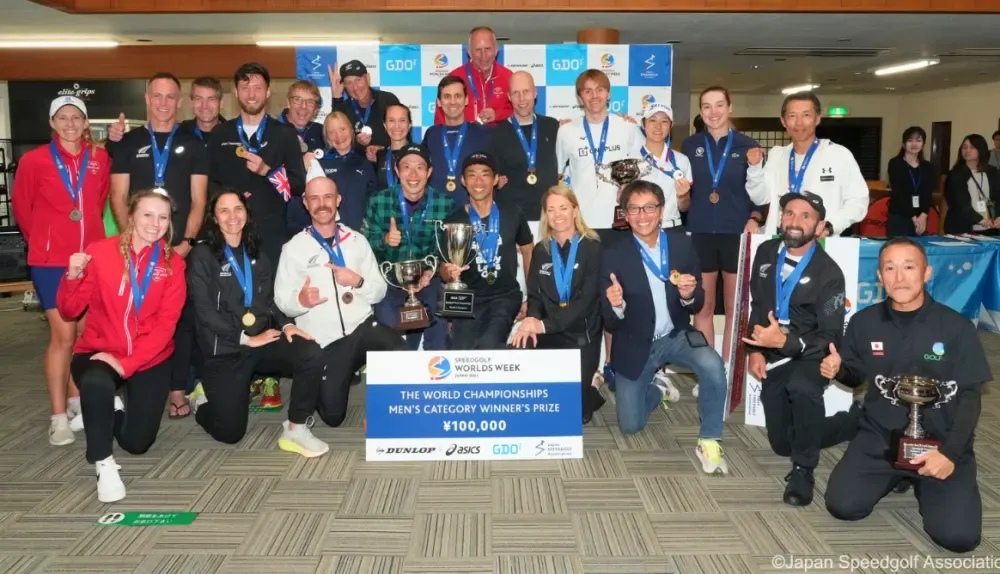
In 2024, we named ten world champions.
- One elite man — Jin Ota
- One elite woman — Liz McKinnon
- One senior man — Marko Kuningas
- One senior woman — Runa Pettersson
- Two men’s pairs champions — Luke Willett & Luke Bone
- Two women’s pairs champions — Liz McKinnon & Amy Linton
- Two mixed pairs champions — Pertti Palosuo & Milla Hallanoro
But I think we need one more award.
I’m serious!
I want to see Team World Championship standings. I know we already do pairs events, but those don’t answer the question I’m asking.
Just like the Olympics show you how many gold medals each country has won, I want to know how the speedgolf nations stack up against each other.
Now, it’s no secret who the most dominant speedgolf nation was two years ago 👇
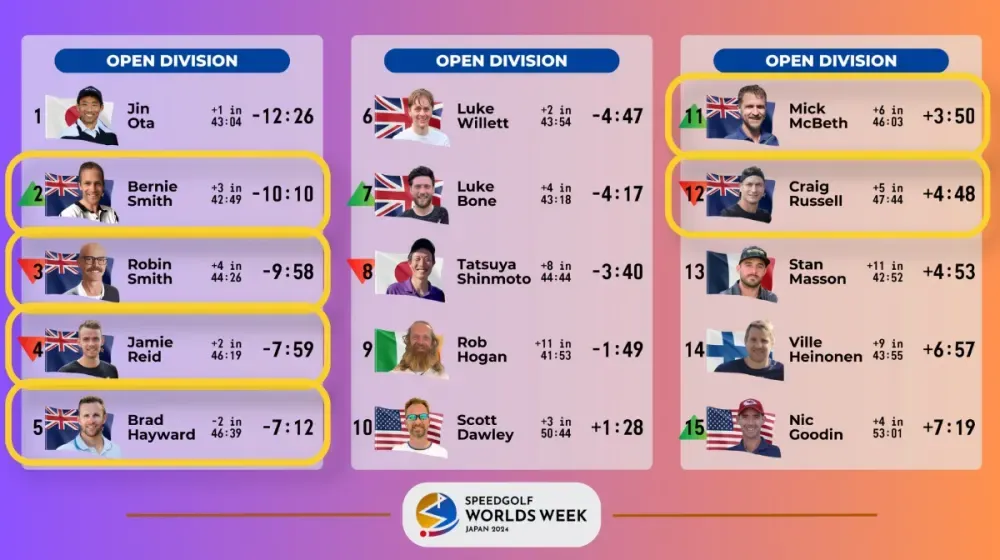
It’s pretty obvious that the team who had four of the top five finishers and six of the top fifteen in the elite men’s field was the most dominant nation. But who was second?
Was it Team Japan? That would make sense. They had the World Champion, the 8th place men’s finisher, the 5th place senior…
I wanted to know for sure. So I went ahead and did the math.
(Before you look at the table, make a prediction. Who were the top three teams at Worlds 2024?)
Scoring methodology. I scored this like a college golf tournament. For each team, the top four scores from each day count toward the team’s total (top two scores in the women’s division to account for field size). A senior man can count toward a men’s team score. A senior woman can count toward a women’s team score.
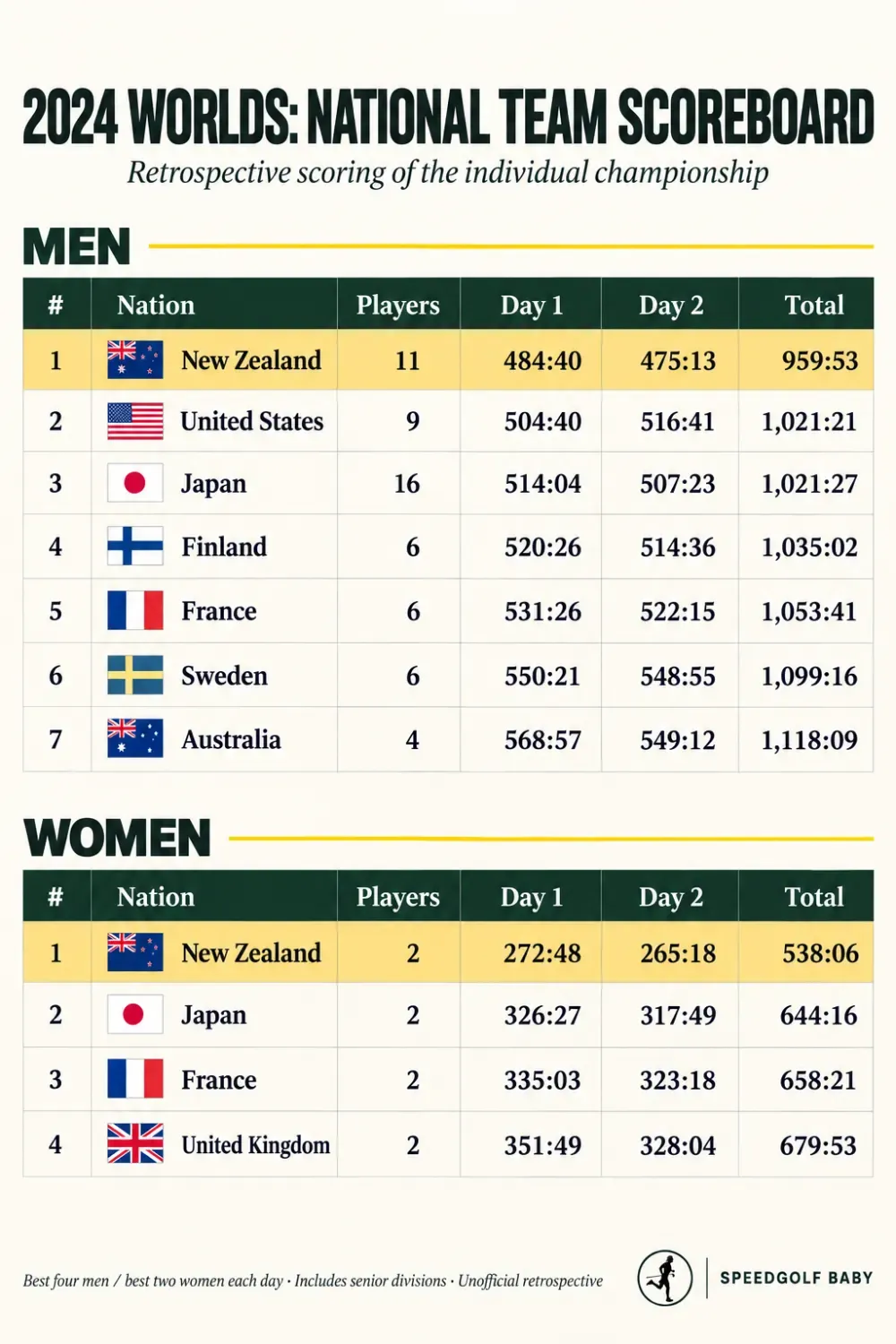
Whoa! Team USA had the second best team? Even though our best player (Scott Dawley) finished 10th?
How did that happen?
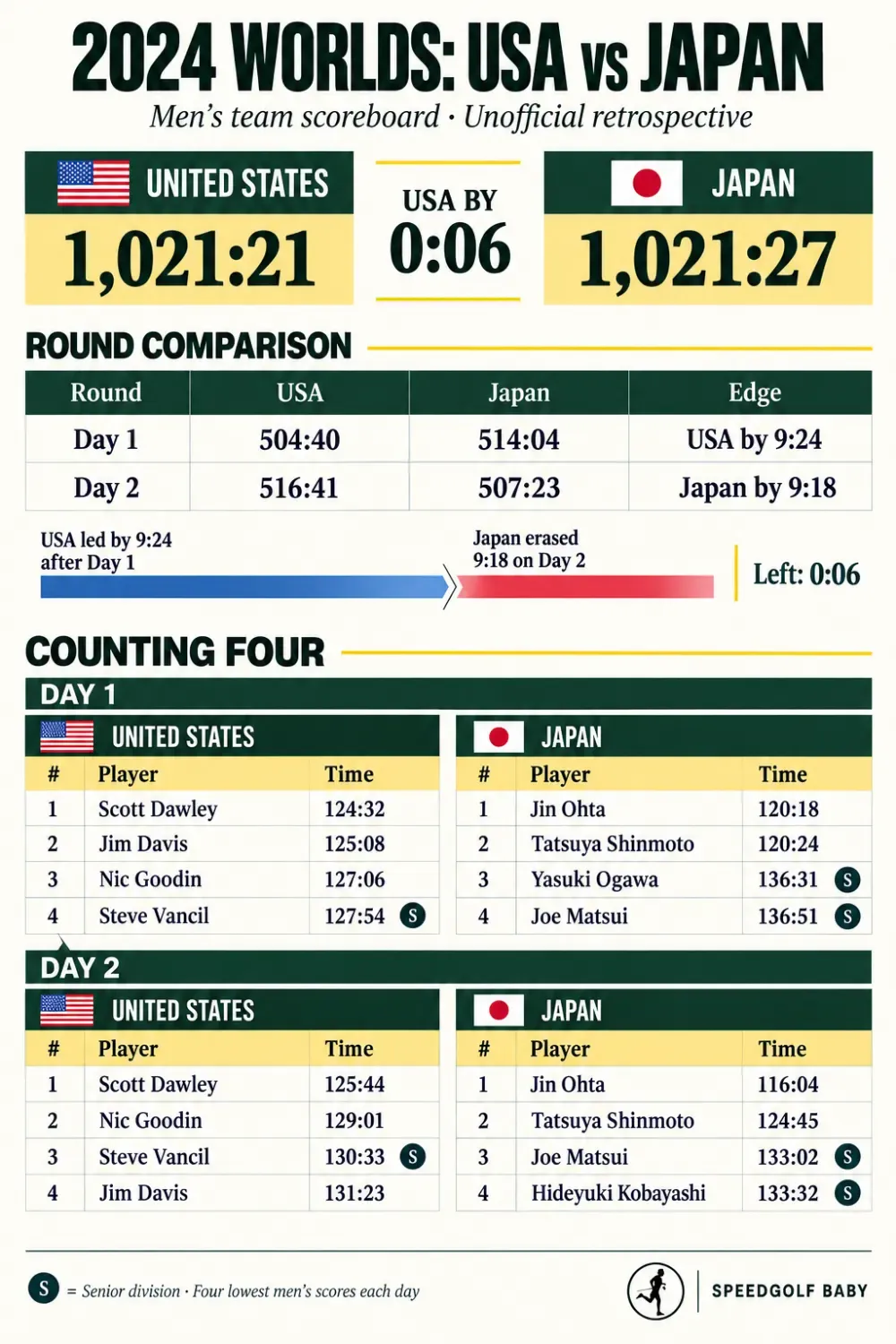
As it turns out, Team Japan had two elite players at the top of the field, but had nobody in the middle of the elite men’s pack. They relied on seniors Joe Matsui, Yasuki Ogawa, and Hideyuki Kobayashi.
Meanwhile Team USA had the same four players scoring on both days.
And while USA led by nine minutes after the first day, it was Jin Ota who closed almost the entire gap!
This would be a good time to remind you that this is all unofficial. I haven’t raised this with the ISGA. You’re hearing about it first.
So let’s not even think about how many committee meetings I’d have to sit through to make this real. Let’s jump back another two years to the 2022 World Championships.
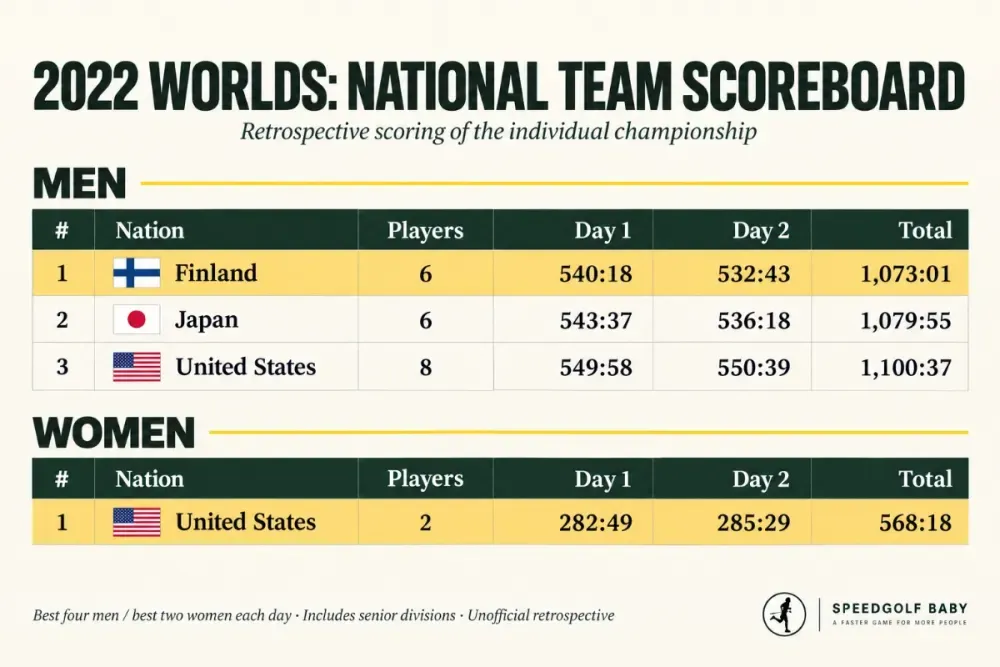
First, compare 2022 to 2024. People wring their hands about whether speedgolf is growing, but look at the difference two years makes! France, Sweden, Australia, and even (gasp) New Zealand didn’t field four players in 2022. The UK didn’t field four men in 2024. This game is growing.
Back in 2022, only three teams brought enough players to count, and it was a tight-but-unambiguous victory for Team Finland.
Let’s see how they did it.
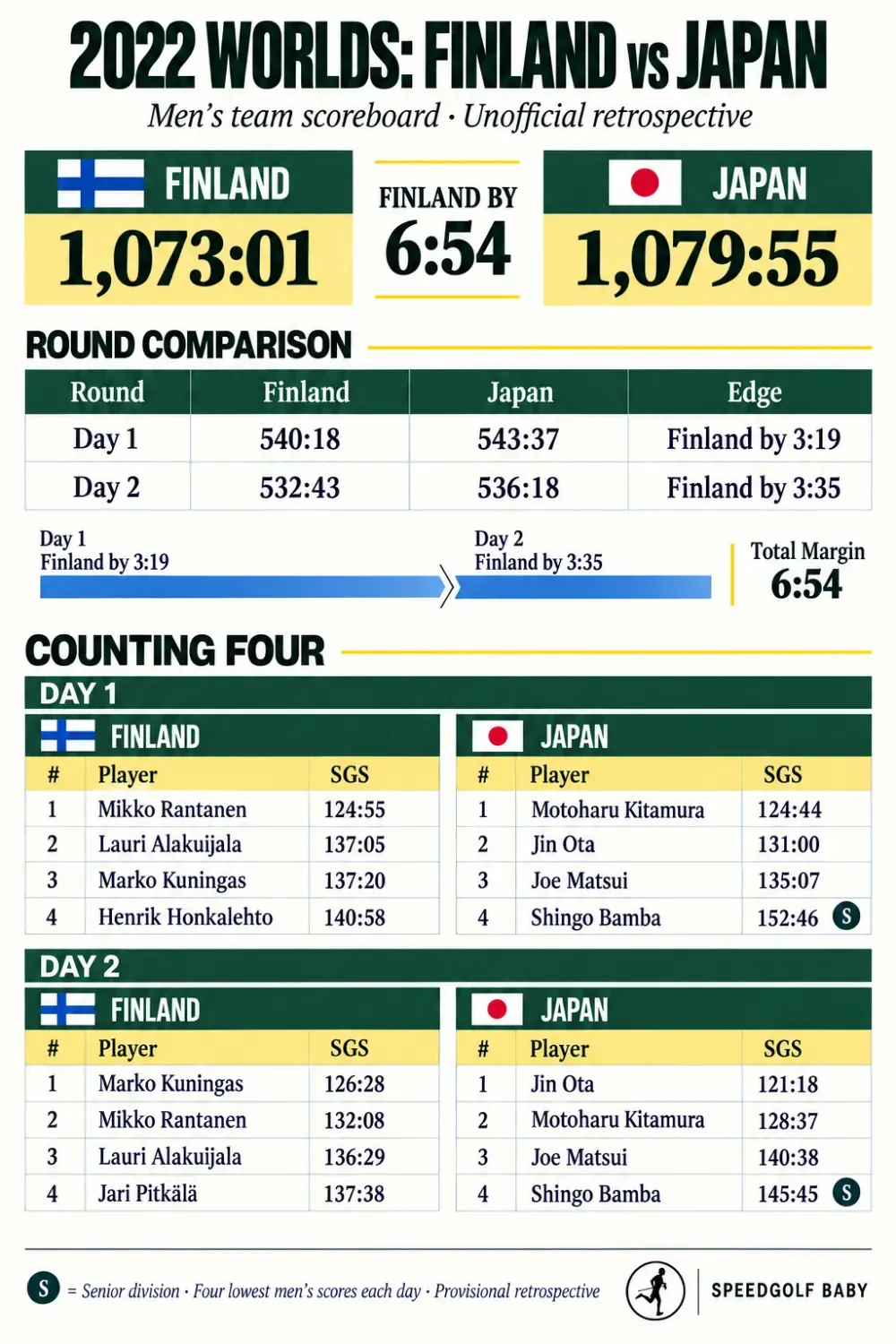
Turns out it was a similar story. Team Japan had two players at the top of the leaderboard, but Team Finland had just enough depth to overcome them.
Now, I think it’s safe to say Team New Zealand will be heavy favorites again in 2026, but it’s not a done deal. I repeat: the UK didn’t field four men in 2024, but look who they’re bringing this year:
- James Hardy
- Will Robson
- Luke Willett
- Luke Bone
If any foursome could derail the Kiwi domination train, it would be that one.
I’ll be tracking this (and many other unofficial metrics) as we get closer to the big dance.
Readers respond

The last couple of issues seem to have touched a nerve. These are real messages from real readers. By request, they’ve been kept anonymous.
Should scorers be randomly allocated at major championships?
With respect to ‘Your Scorer is not your Caddie’, I think it was quite harsh to call out Jason Hawkins specifically. In NZ and AUS it’s common practice at the championships to have family members assigned as caddies (I mean scorers!). Liz McKinnon works with her husband. James McMaster works with his son. This is not a good look for the integrity of the sport. Often at these events we are told the scorer is not allowed to caddie (what is the definition of caddie?) but they can spot balls, rake bunkers, direct you to next tee, carry spare balls and bottles! I think caddies (I mean scorers) should be randomly allocated for all major championships.
I like where this is going. Imagine Robin Smith’s dad showing up, expecting to ride along with his World #1 son, and instead he has to watch me spray it off the tee as I finish ten minutes and fifteen strokes behind the leaders.
But maybe we can take this a bit further. What if—instead of randomly allocating scorekeepers—we have a reverse draft? World #1 picks last. World #50 picks first. If it gets to me in the draft, I’m picking Rob Hogan’s partner in crime Big Bad Bob.
Should the best score win the Open title regardless of age division?
I am disappointed to see that Bev Fentiman was robbed of the British Speedgolf Championship because she was in the Senior category. Playing off the same tees as Kathy Leppard and carrying the disadvantage of age Bev had the better score. How can the best score not be the winner?! At the Open Championship an Amateur playing in the field will be awarded the Claret Jug if they finish with the best score as well as the Silver Medal for low amateur…
As I’ve started saying, “If you play the same tee, the title belongs to thee!”
Which events should count toward world ranking points?
In a previous article about format of events you said Rob Hogan can do what he likes as it’s his event, but should this qualify for World Ranking points? Taking the lead from other sports there are always certain conditions to be met to have “world/ranking/elite” status and that is determined by the governing body. Anybody can run a speedgolf event in any format they like but if it’s to be classified as a world ranking event then the ISGA should specify criteria (minimum course length, par, format, and even how scores and time are recorded).
Are you telling me that Ville Heinonen beating a field of 8 players with one club in a time-only format at the Irish Open should NOT be worth the same number of World Ranking points as Jamie Reid beating a field of 51 players including the two most recent World Record holders at the New Zealand Open? Hmm…
Now, nobody is confused about which is a bigger deal to win. But they do get equal world ranking points. When I talked to ISGA Data Analyst Robin Smith, he told me the point is to encourage speedgolfers to travel to more events. If you really want to climb the world rankings, it would be in your interest to attend the Irish, Finnish, Swedish, and BeNeLux events (because historically they’ve had less-competitive fields).
Should the ISGA mandate that world ranking points can only be awarded for strokes + time events at 6,000+ yard golf courses? I say no. Let speedgolf stay weird. Don’t make us grow up yet.
But there is a certain bias in the world rankings I would like to see addressed…
Are the world rankings geographically balanced?
I love the ISGA World Rankings system. One reason is a common question I get from people who find out I’m a competitive speedgolfer is “are there world rankings somewhere and are you ranked?” I understand we’re all doing this on a volunteer basis, so any beef I have in speedgolf is like a Beyond Burger, not real beef. With that, here are my beefs. One, how many and where players earn points should be included—as Filip did in his rankings. Especially since that data is already being captured to make the rankings. Two, 78% (11 of 14 events) of the eligible ranking events are in Europe or New Zealand. Hardly a fair system given geographic makeup.
As an American who sits on the ISGA World Rankings and World Records committee, this question hit me like a ton of bricks. This is a serious problem, and I signed off on it!
First, here’s my version of the math 👇
I removed Worlds from the calculation because all the top players are there. Worlds is not ‘biased’ toward one region in the same way that, say, the Australian Open is.
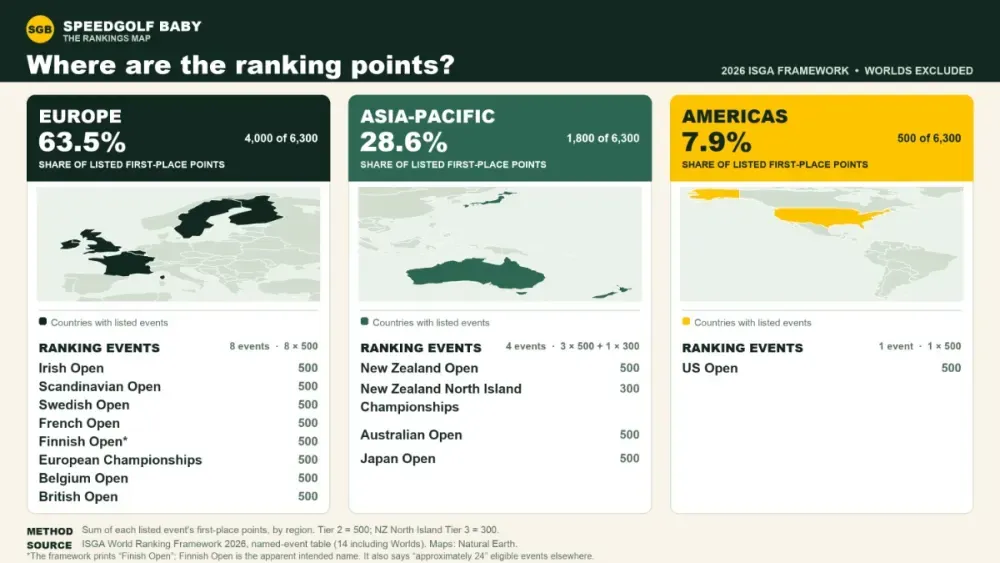
Anyway, the math is clear. You want to climb the ISGA world rankings? Move to Europe. There are 8x as many world ranking points available in Europe as there are in the US and Canada.
Now, there is a certain logic in the ‘national opens’ framework for world ranking points. But let’s not overcomplicate this. Europe has more countries, but the US and Canada have:
- 85% as many people
- 450% as much land area
- 156% of the economic activity
- Hundreds of active speedgolfers
European speedgolf is great, but there is no world where it’s worth 8x as much as American speedgolf.
The Kentucky Speedgolf Open had more players this year than at least three European national opens. I’m not saying it has to be Kentucky that gets the ranking points. I’m just saying this is ridiculous.
And again, I’m part of the problem.
Should elite players face full penalties for rule infractions?
At the British Speedgolf Champoiniships, there were some interesting ruling judgements: one club shaft broke on the first tee, one person dropped a club in the heather and continued without it, another very obvious rule infringement was spotted… Given the nature of the sport, I dont think anyone wants a ball-busting governing body, this seems to be a recurring topic. Do we need to PROTECT THE FIELD or is good natured, sympathetic competition encouraged?
We’ve tiptoed around this issue too long, and I see a fairly elegant solution. For events where there is a designated “Elite” field, elite players should receive full consequences for rule infractions. All players not designated “elite” should be spared from those consequences unless their infractions negatively impact someone else.
For the clearest example, take the British Championships player whose 7-iron snapped on the first tee. The rule states that you must finish with all your equipment, but he left the broken 7-iron in the rough next to the first tee. Now, this player was not in the ‘elite’ category. The broken club didn’t hurt anyone except himself. Not penalizing him was appropriate.
If Luke Willett or James Hardy had done the same thing, I say they should have been required to carry the pieces for 18 holes, or suffer the consequences.
Should speedgolf embrace being a niche sport?
When we talk about growing Speedgolf, we very quickly start talking about numbers.
More players. Bigger fields. More countries. More events. And of course I want that too. But maybe we should stop looking at Speedgolf as a sport that somehow needs to become “big”. Maybe we should actually embrace the fact that Speedgolf is a niche sport. The speedgolf world may not be ready to hear this, but if thousands of people suddenly wanted to Speedgolf every weekend, one of our biggest dreams would very quickly become one of our biggest logistical headaches. Being niche has some nice advantages. At a Speedgolf event, an amateur can warm up next to one of Europe’s best players. A newcomer can join the same event as a world-class Speedgolfer. The competitive part matters. But so does the beer or coffee afterwards. That community feeling is not something we should lose in a desperate attempt to become huge. It is one of Speedgolf’s greatest assets. So maybe the question is wrong. Instead of asking: “How do we make Speedgolf big?” I prefer: “How do we make Speedgolf stronger, more visible, more sustainable — and even more fun?”
All diehard speedgolfers are guilty of this at one time or other. We’re tempted to focus on “growing the game” instead of focusing on making the game something we want to come back to every day. If your goal is growth, you’re never satisfied. For those of us with this tendency, let’s all agree to enjoy what we have, just for a minute.
Almost there…
Thanks to everyone who is supporting my trip to the Speedgolf World Championships in November. If you want to put a little wind in my sails, buy me a coffee on Ko-Fi.
Eight more strokes. Twenty-six seconds ahead.
Ville Heinonen took 65 strokes at Rock Speedgolf. Jari Pitkälä took 57. And Ville won by 26 seconds.
Rock’s September 22 event sent players around its par-27 nine twice, with each stroke counting for 30 seconds. Jari’s eight-stroke advantage was worth four minutes. Ville ran the two loops in 26:29, a full 4:26 faster than Jari, and finished at 58:59 to Jari’s 59:25. That’s what a scoring rule can do: change the price of a stroke, and you change the race.
Milla Hallanoro won the women’s division at 63:24, ahead of Katri Hynninen at 69:06. Official results.
Upcoming speedgolf
Find your next tournament or meetup on Speedgolf Directory. Here’s what I’m looking forward to.
-
Sep 29 — Master Speedgolf
🇫🇮 Master Golf – Master Course · Espoo, Uusimaa
An 18-hole speedgolf event at Master Golf in Espoo, Finland. Event info » -
Oct 3 — Taranaki Speedgolf Open
🇳🇿 Manukorihi Golf Club · Waitara, Taranaki
A two-day, 36-hole Speedgolf tournament plus a 9-hole challenge at Manukorihi Golf Club, open to beginners through elite players. Event info » -
Oct 4 — Australian Par 3 Speedgolf Championships
🇦🇺 Kyabram Golf Club · Kyabram, VIC
Choose a 9- or 18-hole competition in the junior or open division. Event info » -
Oct 5 — Nagoya Bayside Classic
🇯🇵 Wood Friends Nagoya Port Golf Club · Yatomi, Aichi
An 18-hole stop on the Japanese Speedgolf Tour. Entry closed September 25. Event info » -
Oct 25 — 3rd Annual Mohonk Speedgolf Challenge
🇺🇸 Mohonk Golf Course · New Paltz, NY
Rescheduled to Sunday, October 25, with a start expected around 1:00 PM. A 9-hole event; exact schedule is to be confirmed. Course info » -
Nov 1 — Halloween Speedgolf
🇧🇪 Golfschool Gent · Ghent, East Flanders
Junior speedgolf starts at 9:00 AM; the young-adult round starts at 2:00 PM. Both are eight holes. Event info » -
Nov 3–6 — Speedgolf World Championships
🇳🇿 Whitford Park Golf Club · Auckland
The sport’s biggest stage comes to New Zealand for a Worlds Week combining global bragging rights, national pride, and absolutely nowhere to hide. Event info »