
Howdy speedgolf family! You’re reading This Week in Speedgolf.
James Hardy’s belt broke approximately one minute before his tee time at the British Speedgolf Championship.
He won anyway, which is encouraging news for anyone (like me) whose pre-round routine consists mostly of scrambling for equipment.
Here’s what’s happening in speedgolf this week.
Hardy holds steady while the field falls away
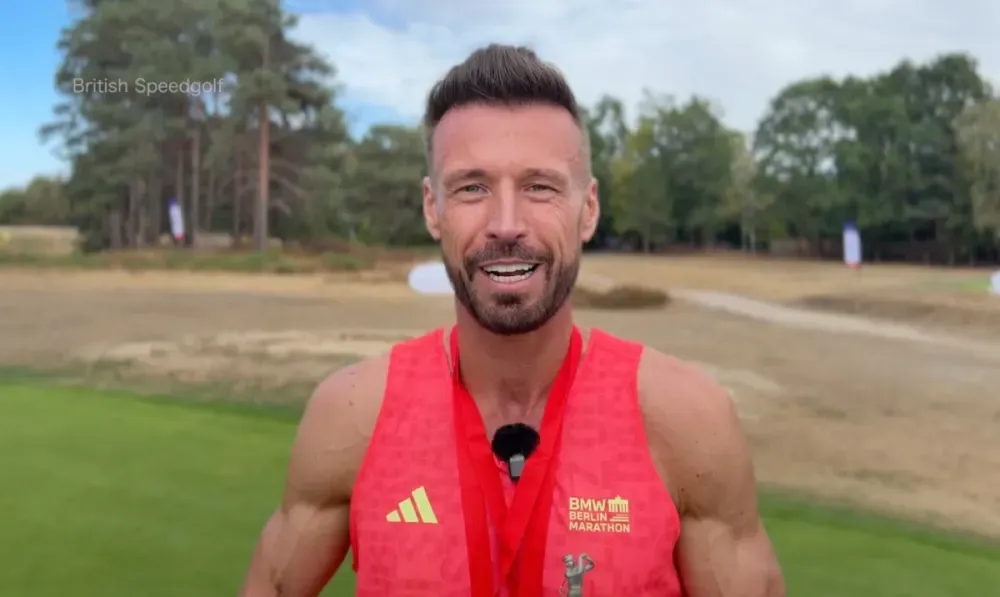
After one round at Sunningdale Heath, this was anybody’s tournament.
Will Robson led after shooting 62 in 25:29 for 87:29. Hardy was 37 seconds back. Luke Bone was 1:42 behind Robson, and two-time World Champ Rob Hogan was 3:03 back after running the fastest round of the championship in 24:32.
Astute readers will remember the British Speedgolf Championships (don’t call it the “British Open” unless you want to get sued into oblivion by the R&A) is the only national open that uses a cut. The top 20 players advance to a same-day 18 hole championship final. Championship contenders get about four hours rest in between rounds.
Back to our story.
The second time around, Hardy shot 61 (+3) in 25:55. Robson shot 64 in 26:22. Hogan shot 73. Bone shot 75.
By the end, Hardy had won his second straight British title—and his fourth consecutive major championship—with a two-round score of 175:01. Robson finished second at 177:51, followed by Chris Parry at 185:59.
The win bumped Hardy up to 2nd in the ISGA world rankings (more on that below).
British Speedgolf Championship | Sunningdale Heath Golf Club, England | September 6 | (results)
- Open: James Hardy (GBR) | 63/61 in 25:06/25:55 | 175:01
- Amateur Men: George Boxall (GBR) | 65 in 26:00 | 91:00
- Women: Kathy Leppard (GBR) | 79 in 41:35 | 120:35
- Senior Amateur Men: Ben Walmsley (GBR) | 65 in 31:58 | 96:58
- Senior Amateur Women: Beverley Fentiman (GBR) | 80 in 38:57 | 118:57
- Junior: Callum Neill (GBR) | 68 in 29:26 | 97:26
The Open title was decided over two rounds after a top-20 cut. The division titles were decided by the first-round scores shown above.
When you look at the championship final, the story seems simple to me. Hardy and Robson stayed about the same while everybody else got worse.
That’s not literally true—Parry, Luke Willett, Will Major, and several others improved—but it captures what happened among the four men who were packed together at the top after round one.
Hardy’s speedgolf score improved by 1:11. Robson lost 2:53 but stayed close. Hogan lost 8:20. Bone lost 14:51.
The difference was mostly golf. Hardy and Robson shot 61 and 64 in the afternoon. Hogan and Bone shot 73 and 75. Their running times stayed in roughly the same neighborhood, but Hardy and Robson gained nine to fourteen shots on the other two contenders.
Speaking of golf scores carrying the day (sharp inhale from Rob Hogan), let’s talk about the golf course.
Sunningdale Heath is a compact par 58. The leaders can finish it in roughly 25 to 30 minutes. A normal championship course can take the same athletes 40 to 50 minutes to run.
Traditional speedgolf scoring—one stroke equals one minute—is the status quo for good reason. It is simple, understandable, and has served the sport well.
But it cannot reward exactly the same balance of running and golf skill on every layout.
If a course only takes 26 minutes to run, golf will dominate the final score. On a five-mile course that takes 45 minutes, the clock has much more room to separate the field. Same scoring system. Very different test.
That is not necessarily a problem. Some championships can be golf exams. Others can reward the runners. Course variety is part of the sport.
But if the goal is to reward roughly the same balance of golf and running everywhere, scoring may eventually need to account for the layout.
That conversation can wait for another day. For now, Hardy has won four majors in four different settings, and his floor appears remarkably high. Even when the golf starts badly—he was four over through four holes in round one—he does not disappear.
Does that make him the odds-on favorite for Worlds?
Absolutely not. Settle down.
My pre-Worlds power rankings will arrive next month. I am attempting something called restraint.
Nic Goodin plays lights-out golf to win in Missouri
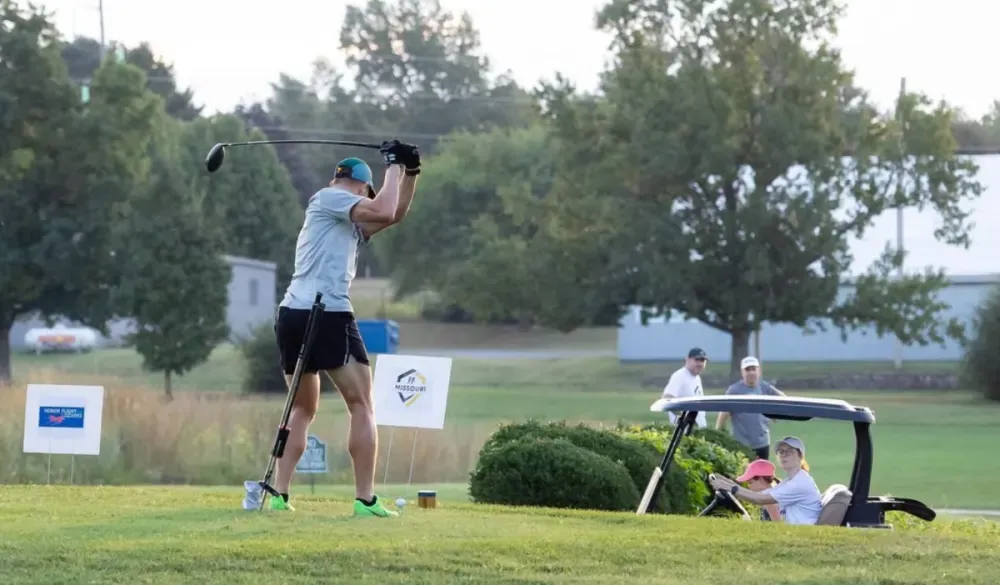
Nic Goodin (The Southpaw from Springfield) won the Missouri Speedgolf Open this past weekend, shooting level par golf that included a hole-out eagle on the 17th hole. Shooting two-under would be anything but boring for me, but Nic said: “I just LOVE boring golf, and was fortunate to get roughly 30 holes of boring golf over the weekend 😎”
Nic is in the best form we’ve seen in recent memory, after finishing as the top American at the US Open and—along with Garrett Holt—toppling the British Pairs champions in the US Open team event.
Congrats to first-timer and astute reader Yale Hughes for breaking 80 strokes and 50 minutes in his first two competition rounds, and finishing as Open division runner-up!
According to reports from Springfield, there were quite a few first-timers, which is great for the growth of the sport, but made it challenging to assemble the tee sheet. Maybe next time, players will need to send in an audition tape like they’re trying out for Survivor!
Missouri Speedgolf Open | Horton Smith Golf Course, Springfield, Missouri | September 6-7 | (results)
- Open: Nic Goodin (USA) | 72/68 in 47:30/45:30 | 233:00
- Amateur: Jordan Dickson (USA) | 81/75 in 51:35/50:21 | 257:56
- Senior: Marc Stephens (USA) | 97/93 in 93:15/82:14 | 365:29
- Legends: Andy Dalton (USA) | 80/72 in 66:13/61:35 | 279:48
- 9-Hole Junior: Kenzie Baker (USA) | 41 in 33:19 | 74:19
- 9-Hole FlingGolf: Courtney Landis (USA) | 38 in 21:59 | 59:59
Your scorekeeper is not your caddie
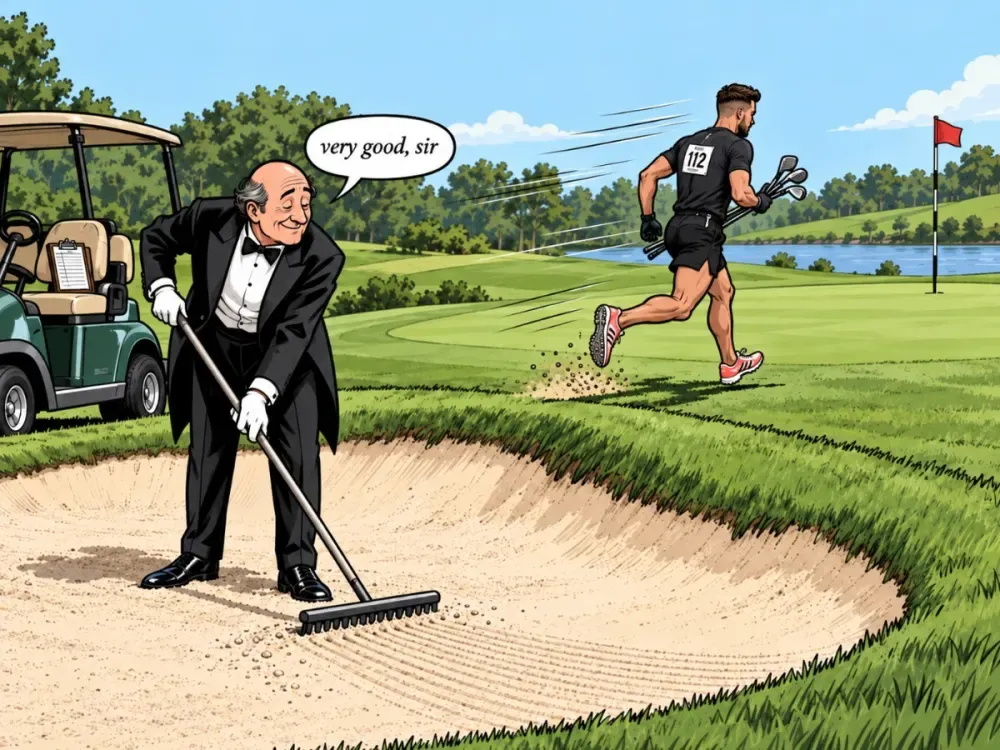
Of more interest to the broader community, perhaps, was tournament director Garrett Holt’s decision that scorekeepers were to remain on the cart paths. I’m told this happened at the US Speedgolf Open as well.
Their job was to keep score. They were not there to rake bunkers, read putts, recommend clubs, or conduct a personal search party every time somebody hit one toward a neighboring zip code.
On holes with difficult sightlines, Garrett stationed shared spotters who helped everyone.
I love this.
The distinction between scorekeeper and caddie matters more than speedgolf has traditionally admitted.
And this is not only an American question. A competitor at the British Championship independently asked where the line falls. Can your scorer find balls? Rake bunkers? Clear leaves? Put tees in the ground? Read your putt before you arrive?
The same competitor said anticipatory starts were prolific among the Elite field. At the Scandinavian Open, Rob Hogan received a one-stroke penalty for starting early and missed the podium by four seconds. At the British Championship, nobody appears to have been called back or penalized.
My current working theory is that British Speedgolf has rules, but enforces them primarily through meaningful eye contact.
Back to scorekeepers. Let’s take my favorite local-ish event: the Kentucky Speedgolf Open, where host Jason Hawkins has won the event six of the seven times he’s teed it up. Sure, Jason is an incredible athlete with elite hand-eye coordination and insane cardiovascular fitness.
But in Kentucky, Jason has one other competitive advantage you won’t see on a VO2 Max test or a golf simulator. It’s the fact that he gets to hand-pick his scorekeeper. He’ll always have somebody who knows the course like the back of their hand, who knows Jason’s game, and who will help do the little things that give you back a few seconds every time, like spotting golf balls.
Nobody is breaking a rule (as the rules are currently written). But a randomly-assigned volunteer would be a big time downgrade for Jason.
The cleanest answer is not to ask every scorekeeper to become an equally talented assistant. We level the playing field by keeping the scorekeepers’ responsibilities contained.
Where players genuinely need help—blind tee shots, severe glare, tall rough—the tournament should provide neutral spotters for the entire field.
I’d like to see Speedgolf USA adopt this standard for all events. And I’d like to see the ISGA establish a clear international standard before Worlds.
Or we should just admit that traditional golf is onto something with this ‘caddie’ concept and accept that a great caddie is essential for success at the top level.
The world rankings are out. Now try using them.
The ISGA has released its September world rankings, with Robin Smith and Emily Mollard holding the top spots.
Men’s world rankings
| Rank | Athlete | Nation | Points |
|---|---|---|---|
| 1 | Robin Smith | NZL | 423 |
| 2 | James Hardy | GBR | 373 |
| 3 | Jin Ota | JPN | 332 |
| 4 | Carl Palmberg | SWE | 304 |
| 5 | Luke Willett | GBR | 283 |
| 6 | Bernie Smith | NZL | 225 |
| 7 | Rob Hogan | IRE | 211 |
| T8 | Brad Hayward | NZL | 200 |
| T8 | Will Robson | GBR | 200 |
| 10 | Jamie Reid | NZL | 175 |
| 11 | Lauri Alakuijala | FIN | 168 |
| 12 | Ville Heinonen | FIN | 164 |
| 13 | Harry Bateman | NZL | 125 |
| T14 | Ben Taylor | AUS | 125 |
| T14 | Joakim Wikland | SWE | 125 |
| 16 | Will Major | GBR | 104 |
| 17 | Olivier Guisset | BEL | 96 |
| T18 | Riley Davie | AUS | 89 |
| T18 | Marko Kuningas | FIN | 89 |
| T20 | Stanislas Masson | FRA | 71 |
| T20 | Eetu Isometsa | FIN | 71 |
| 22 | Alexandre Arguel | FRA | 66 |
| 23 | Tatsuya Shinmoto | JPN | 54 |
| 24 | Craig Russell | NZL | 50 |
| 25 | Mikael Palmberg | SWE | 47 |
Women’s world rankings
| Rank | Athlete | Nation | Points |
|---|---|---|---|
| 1 | Emily Mollard | FRA | 500 |
| 2 | Kathy Leppard | GBR | 356 |
| 3 | Liz McKinnon | NZL | 339 |
| 4 | Beverley Fentiman | GBR | 329 |
| 5 | Meguna Haga | JPN | 286 |
| 6 | Colette Blacklock | AUS | 246 |
| 7 | Amy Linton | NZL | 214 |
| 8 | Milla Hallanoro | FIN | 211 |
| 9 | Runa Pettersson | SWE | 204 |
| 10 | Britta Uschkamp | GER | 196 |
| 11 | Paige Vancil | USA | 125 |
| 12 | Lauren Cupp | USA | 114 |
| T13 | Lucinda Searle | NZL | 89 |
| T13 | Angela Campbell | NZL | 89 |
| T15 | Majken Palmberg | SWE | 71 |
| T15 | Anna Hedlund | SWE | 71 |
| 17 | Shelley Baxter | GBR | 64 |
| 18 | Nannick Bast | NED | 61 |
| T19 | Emma Johnstone | GBR | 54 |
| T19 | Camille Gollety | FRA | 54 |
| T19 | Katri Hynninen | FIN | 54 |
| T19 | Katie Humphrey | USA | 54 |
| T19 | Ingrid Noak | AUS | 54 |
| T19 | Alice Landon-Rouly | FRA | 54 |
| T25 | Tina Bielecki | USA | 36 |
| T25 | Alexia Neuville | FRA | 36 |
The big winners are Hardy and Kathy Leppard. Both have paired excellent speedgolf with the ability to travel to enough significant tournaments for those results to accumulate.
The relative loser is Jamie Reid, who fell from eighth to tenth despite winning the New Zealand Open over elite competition in his most recent outing.
This does not mean the ISGA has concluded that nine men are more likely than Jamie to win a speedgolf tournament. It means nine men have built stronger résumés under this particular system over the last 24 months.
The rankings are, at their heart, a contest combining speedgolf skill and travel budget.
And—for the first time—we can actually see how the contest works. The ISGA has published its 2026 ranking framework.
I read it so you don’t have to.
Ok, that wasn’t true. Let me try again.
I fell asleep trying to read it and then asked ChatGPT to break it down for you.
Athletes earn points based on finishing position and event tier over a rolling 24-month window. The point total is divided by at least seven starts, even if the athlete has played fewer than seven ranking events. Once an athlete plays more than seven, the divisor becomes their actual number of starts.
That minimum divisor matters. One Tier 2 victory is worth 500 raw points, but only 71.43 ranking points after being divided by seven. It rewards strong finishes, but it also rewards assembling a fuller international schedule.
Does the methodology make sense? Yes, for what it is trying to measure. It produces a coherent résumé ranking. The trouble begins only if we confuse that with a power ranking, which is trying to tell you who would win if everybody showed up tomorrow. (That’s what I’m going to attempt leading up to Worlds.)
But the methodology is only the innermost circle of this story. The next question is how the sport presents all this information to an actual human being.
Filip Beerens recently launched PlaySpeedgolf.eu. After the customary European welcome ceremony—approximately five GDPR compliance pop-ups—you are greeted by upcoming events, country pages, and real ranking tables.
The tables contain names, nationalities, points from each tournament, totals, and speedgolf handicaps. You can switch between the Order of Merit and Speedstache Classification. The page tells you when it was updated. The information is structured, readable, and useful.
On PlaySpeedgolf.com, the official world rankings are press releases pasted onto the page as images. If the site’s occasional dark text on a dark background has not already encouraged you to pursue a less information-intensive hobby, you can scroll to a picture of a document and inspect the rankings with your human eyeballs.
You cannot sort the table. You cannot search the names. You cannot copy the data. A search engine cannot reliably understand it. It is technically online in the same sense that a photograph of a spreadsheet is a database. Gee whiz.
This is not really a complaint about graphic design. It is a complaint about whether speedgolf information can move.
Structured results can feed rankings, athlete pages, tournament histories, graphics, broadcasts, and stories. An image can be looked at. Then somebody has to type it all out again.
The American side of speedgolf is currently far behind Europe in building that connective tissue. Filip did not wait for a committee or an international data standard. He built something, connected the events, and made the information usable.
I’m told not every newsletter needs to become a sermon about speedgolf data infrastructure.
I remain unconvinced.
This week in speedgolf media
🏆 James Hardy wins his fourth consecutive major—British Speedgolf’s recap includes the winning rounds, the full SpeedScore leaderboard, and Hardy’s remarkable twelve-month rise from newcomer to repeat national champion.
📰 Hardy’s 61 reaches the mainstream golf press—Golf Monthly leads its speedgolf item with Hardy’s 61 in 25:55, Robson’s runner-up finish, and Ben Walmsley’s championship-first hole-in-one.
🌅 Garlin Smith builds Speedgolf SoCal before sunrise—Spectrum News visits the less-glamorous side of speedgolf growth: Garlin showing up week after week at 5:15 a.m. to guide players around the course with headlamps and glow balls. The sun is not up, but the club is.
Almost there…
Thanks to everyone who is supporting my trip to the Speedgolf World Championships in November. We are 73% of the way to our goal.
If you want to put a little wind in my sails, buy me a coffee on Ko-Fi and help me get to New Zealand, where I’ll be publishing daily.
Upcoming speedgolf
Find your next tournament or meetup on Speedgolf Directory. Here’s what I’m looking forward to.
-
Sep 18 — Aura Speedgolf
🇫🇮 Aura Golf · Turku, Southwest Finland
An 18-hole Finnish speedgolf event at Aura Golf in Turku. Sign up » -
Sep 19 — Speedgolf SM 2026 — SM Foursome (Swedish Championship)
🇸🇪 Haningestrand GC
A rare alternate-shot title where teamwork, rhythm, and trust matter just as much as speed. Sign up » -
Sep 20 — Spartan Speedgolf Challenge
🇧🇪 Five Nations Golf Club · Méan, Namur
A Belgian speedgolf challenge at Five Nations Golf Club in Méan. Sign up » -
Sep 22 — Rock Speedgolf
🇫🇮 Rock Golf · Siuntio, Uusimaa
A two-by-nine-hole speedgolf event at Rock Golf in Siuntio. Sign up » -
Sep 27 — 3rd Annual Mohonk Speedgolf Challenge
🇺🇸 Mohonk Golf Course · New Paltz, NY
The 3rd Annual Mohonk Speedgolf Challenge will be held Sunday, September 27, with an afternoon start expected around 3 p.m. Sign up » -
Oct 3 — Taranaki Speedgolf Open
🇳🇿 Manukorihi Golf Club · Waitara, Taranaki
A two-day, 36-hole tournament plus a nine-hole challenge, open to beginners through elite players. Sign up » -
Oct 4 — Australian Par 3 Speedgolf Championships
🇦🇺 Kyabram Parkland Golf Club · Kyabram, VIC
A test built around short-game precision, running speed, and early-spring sharpness. Sign up » -
Oct 5 — Nagoya Bayside Classic
🇯🇵 Wood Friends Nagoya Port Golf Club · Nagoya, Aichi
A weekday Japanese tour stop on a quick bayside track. Sign up »