
Coach
Today, let’s tee up a question that sounds simple: What are you actually trying to accomplish with a tee shot in speedgolf?
Student
Hit the fairway?
Coach
That is one possible answer. But before we decide, remind me what determines a speedgolf score.
Student
Speedgolf score equals golf strokes plus total time. And total time consists of run time plus golf time.
SGS = 60(strokes) + run seconds + golf seconds
Coach
Good. So should we evaluate a tee shot according to whether it hits the fairway?
Student
Not directly. We should evaluate how much it changes expected SGS.
Coach
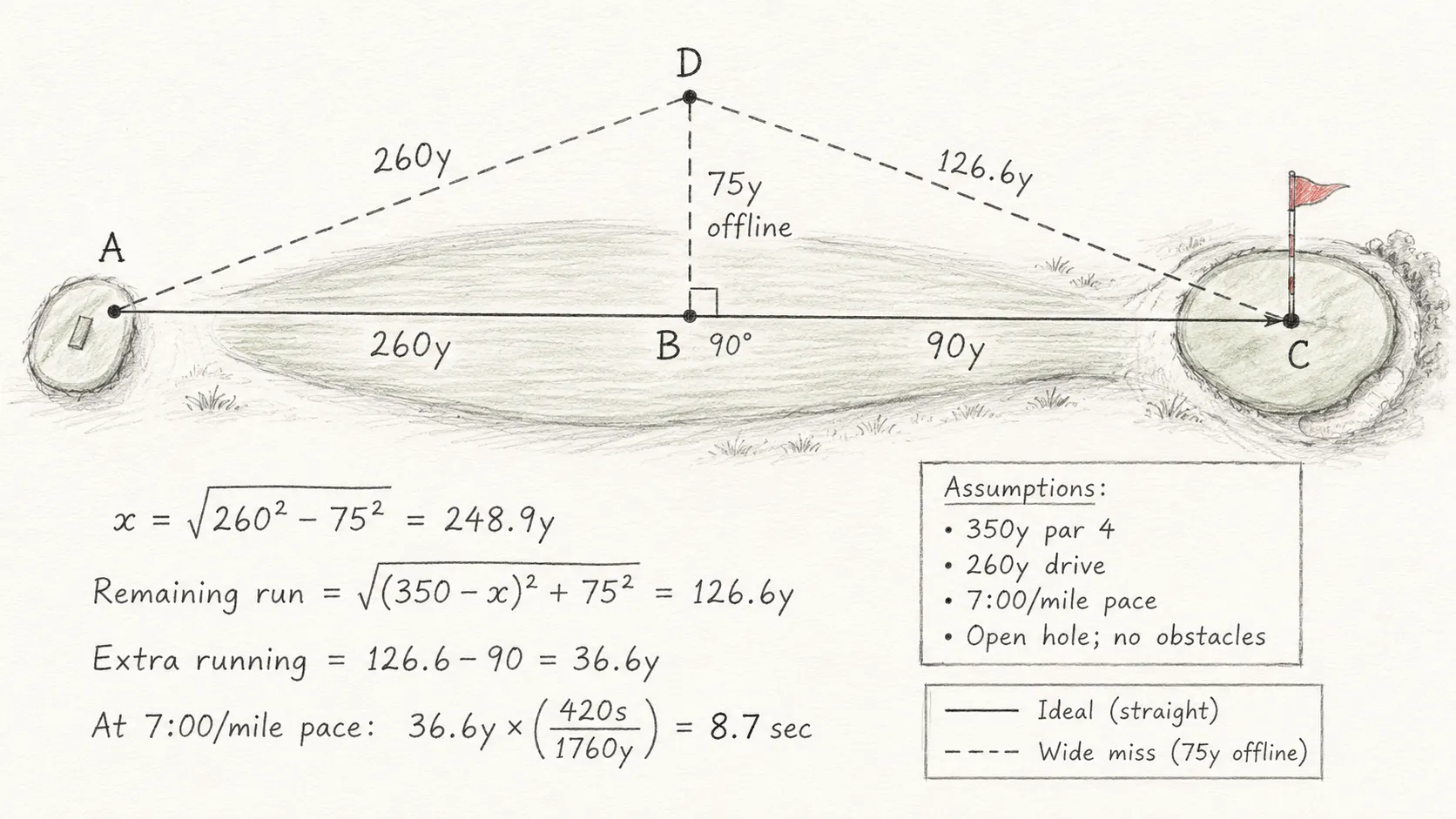
Exactly. Imagine a wide-open 350-yard par 4. You hit driver 260 yards and run at a seven-minute-mile pace. A straight drive leaves you 90 yards from the hole.
Suppose your drive finishes 25 yards offline. How much extra running does that create?
Student
A 25-yard miss adds only about 4.6 yards to the total route. At seven-minute-mile pace, that is about 1.1 seconds.
Coach
What about 50 yards offline? And 75?
Student
Fifty yards offline adds about 17 yards of running, or roughly four seconds. Seventy-five yards offline adds about 37 yards, or approximately nine seconds.
Coach
Does that support the claim that offline drives are inherently very expensive because of the extra running?
Student
No. Not on an open hole. Even a huge 75-yard miss costs less than ten seconds from running distance alone.
Coach
Your ball finishes in ordinary rough, 25 yards offline. You have a clear shot at the green, and we assume no difference in execution time or expected golf score compared with the fairway. What did the miss cost?
Student
About one second. The fairway can improve the next shot, but “fairway” is not automatically worth much. Its value depends on what the alternative lie actually costs.
Coach
Now consider an obvious out-of-bounds drive. Under our speedgolf rules, you do not return to the tee. You immediately use the assumed location of the ball and drop in the fairway, no closer to the hole, with a one-stroke penalty (Speedgolf-modified USGA Local Rule E-5). Suppose dropping takes four seconds. What is the SGS cost?
Student
One penalty stroke is 60 seconds, plus four seconds to drop. So about 64 seconds.
Coach
Your next drive enters tall grass. It looks findable. You spend five extra seconds watching from the tee, then ten seconds searching, and you find it. What did that cost?
Student
Fifteen seconds.
Coach
Same shot, but you search for thirty seconds and do not find it. Then you take the one-stroke penalty and spend four seconds dropping.
Student
Five seconds watching, plus thirty searching, plus sixty for the penalty, plus four to drop. That is 99 seconds.
Coach
Which is worse: the obvious out-of-bounds ball or the apparently findable ball that you search for unsuccessfully?
Student
The unsuccessful search is much worse: about 99 seconds instead of 64. The uncertainty adds wasted golf time before I pay essentially the same penalty.
Coach
Suppose there is a 50% chance of finding the ball, and search time averages twenty seconds. What is the expected cost?
Student
I always lose the five seconds watching and twenty seconds searching. Half the time I also lose a stroke and four seconds for the drop:
5 + 20 + 0.5(60 + 4) = 57 seconds
So the expected cost is about 57 seconds.
Coach
Now let’s consider a fairway bunker. Suppose the bunker adds five seconds of setup, ten seconds of raking, and 0.3 expected golf strokes compared with a fairway lie. Calculate the SGS cost.
Student
The fixed time cost is 15 seconds. The expected stroke cost is 0.3 times 60, or 18 seconds. The total is about 33 seconds.
Coach
How does that compare with being 50 yards offline in ordinary rough with a clear shot?
Student
The ordinary rough might cost about four seconds from the extra running. The bunker costs around 33 seconds. The category “missed fairway” hides a huge difference between outcomes.
Coach
Imagine a drive that is easy to find but finishes behind trees. The player must punch out. We estimate that a speedgolfer makes bogey or worse 90% of the time from that situation, compared with 40% after a normal drive into the open. Using a simplified par-or-bogey model, what is the expected stroke difference?
Student
The difference is 0.50 strokes, or 30 seconds. If the punch-out adds another five to ten seconds, the total cost is around 35 to 40 seconds.
Coach
So is the problem that the ball is offline?
Student
Not really. The problem is that it has no direct route to the green.
Coach
Now let’s return to club selection. Many new speedgolfers say, “I should hit 3-wood because it is safer.” What would you ask them?
Student
I would ask what “safer” means in measurable terms. Does the 3-wood actually have a narrower shot pattern? Does it reduce penalties, searches, bunkers, or punch-outs? Or does it merely go shorter?
Coach
Suppose driver travels 20 yards farther and has approximately the same dispersion as 3-wood. What is the likely golf value of those 20 yards over a full round?
Student
Roughly 1.4 to 1.5 strokes, depending on the player and course. In SGS terms, that is around 84 to 90 seconds.
Coach
Does driver have any speedgolf-specific cost?
Student
It usually requires a tee. I need to include the additional time required to retrieve the tee, place it, set the ball, and possibly recover the tee afterward.
Coach
If that process takes four additional seconds on fourteen holes?
Student
That is 56 seconds. An 84-second distance benefit would be reduced to roughly 28 seconds.
Coach
And if teeing takes eight extra seconds per hole?
Student
That would be 112 seconds, which could outweigh the distance advantage. But that may be an argument for improving the teeing process. The tee cost is partly a skill and equipment-design problem, not an unavoidable constant.
Coach
What else must we consider when choosing between driver and 3-wood?
Student
The whole bag, especially on par 5s. A 3-wood can be used from the tee and from the ground.
For example, 3W + 3W = 445 yards, while Driver + 7I = 415 yards. A bag built around 3-wood might travel farther in two shots.
Coach
Let’s finish by ranking the possible outcomes from our 350-yard tee shot.
Student
From most desirable to least:
- Straight drive in the fairway: baseline
- Twenty-five yards offline with a clear shot: 1 second
- Fifty yards offline with a clear shot: 4 seconds
- Ball found quickly in tall grass: 15 seconds
- Fairway bunker: 33 seconds
- Findable ball requiring a punch-out: about 35 to 40 seconds
- Uncertain ball in tall grass: 57 seconds expected
- Obviously out of bounds with an immediate drop: 64 seconds
- Long unsuccessful search followed by a penalty drop: 99 seconds
The exact order of the bunker and punch-out could change depending on the player and lie.
Coach
And in plain English, how should a speedgolfer approach tee shots?
Student
I should not obsess over hitting the fairway or assume that 3-wood is automatically safer. I should hit the club that produces the lowest expected SGS for the whole bag and course.
Ordinary lateral misses are often cheap because the extra running distance is small. The outcomes I really need to avoid are the ones that create penalties, uncertain searches, blocked shots, bunker procedures, or large expected stroke losses.
Distance has substantial value, so I should not give it away merely to make my shot look straighter. But I also should not chase distance if it materially increases catastrophic outcomes.
The goal is not to hit the prettiest tee shot. It is to advance the ball as far as practical while keeping the expensive tails of the outcome distribution under control.