
Coach
Today, let’s move close to the green. What are you trying to accomplish with your short game in speedgolf?
Student
Get up and down as quickly as possible.
Coach
That sounds reasonable. But which part matters more: the “up and down,” or the “quickly”?
Student
Both. A stroke costs a full minute, so I cannot just rush and make mistakes. But I also cannot take forever playing careful golf.
Coach
Good. Remind me of the basic speedgolf equation.
Student
Speedgolf score equals golf strokes plus total time.
So:
SGS = golf strokes + run time + golf time
Or in seconds:
SGS = 60(strokes) + run seconds + golf seconds
Coach
So when you stand near the green with a chip, pitch, putt, or bunker shot, what are you actually trying to minimize?
Student
Expected SGS. Not just strokes, and not just time.
Coach
Exactly. Let’s start with an easy case. Your ball is on the fringe or in closely mown grass, with a clear path to the hole. What club should you usually use?
Student
The putter. Putting is low risk. It is hard to chunk, blade, or leave in a bunker. And if the putter is already in my hand, I do not have to switch clubs.
Coach
Suppose switching wedge back to putter costs three to five seconds. What does the wedge need to do to justify that switch?
Student
It needs to save at least three to five seconds in expected SGS. Since one stroke is sixty seconds, that means it needs to improve the expected golf outcome by at least:
3 ÷ 60 = 0.05 strokes
to
5 ÷ 60 = 0.08 strokes
Coach
Is that impossible?
Student
No. A chip might be better if there is a sprinkler head, thick fringe, a big slope, or some other feature that makes putting unreliable.
Coach
But absent that?
Student
Putt. If the ball can roll safely, putting is usually the lowest-risk choice.
Coach
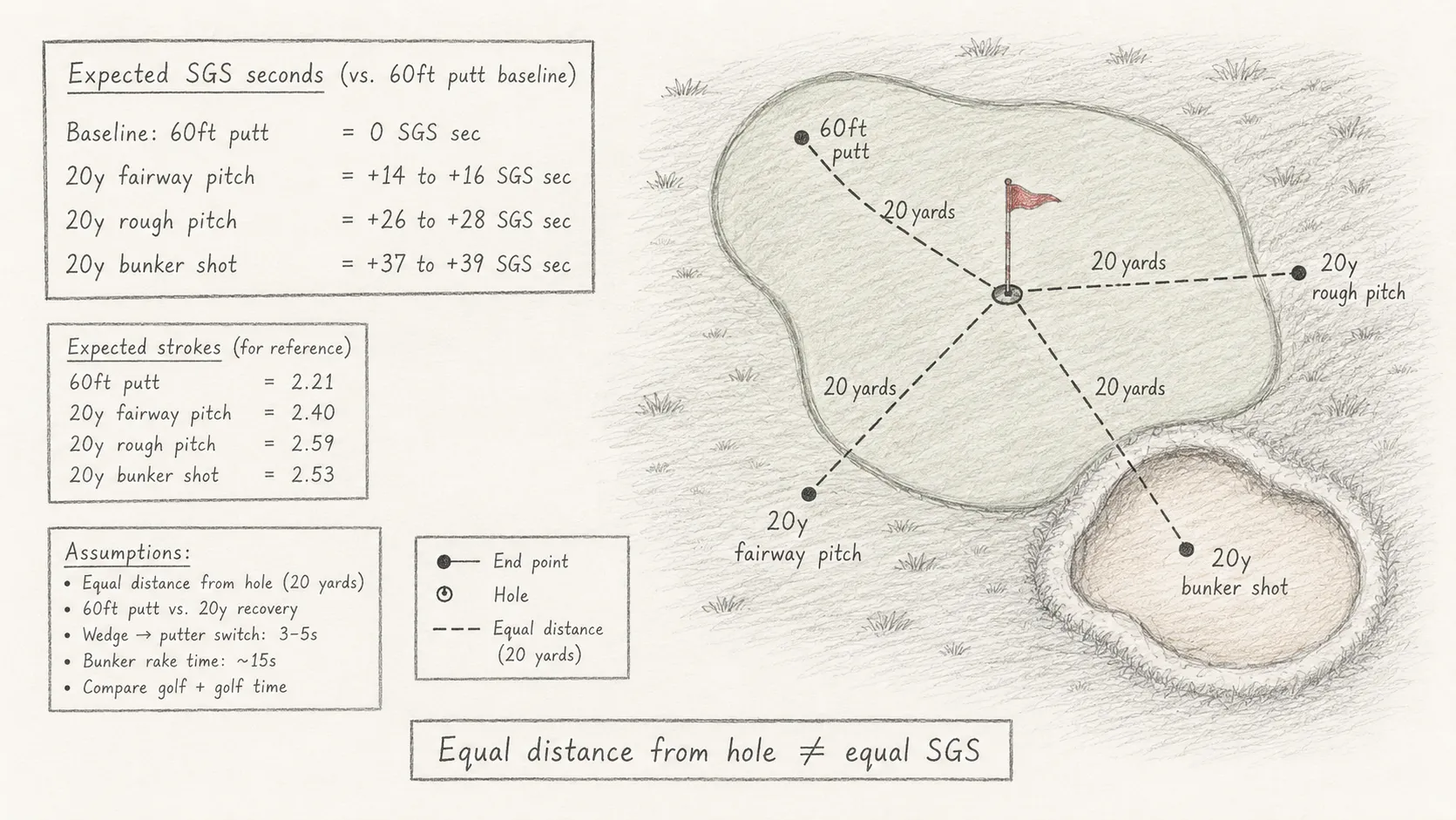
Now suppose the ball is twenty yards from the hole. One version is on the green, leaving a sixty-foot putt. Another version is short of the green, leaving a twenty-yard pitch from closely mown grass. Are those equivalent?
Student
No. The putt is usually better.
Coach
Why?
Student
We’ve covered this. A long putt has lower expected strokes than a pitch from off the green, and it avoids a club transition. Here’s what we decided:
- 60-foot putt: 2.21 strokes to hole out
- 20-yard fairway pitch: 2.40 strokes + club switch time = adds 14-16 SGS seconds
- 20-yard rough pitch: 2.59 strokes + club switch time = adds 26-28 SGS seconds
- 20-yard sand shot: 2.56 strokes + club switch time + raking time = adds 37-39 SGS seconds
Coach
Very good. Now let’s talk about the actual short-game shot. Suppose a golfer has a choice between a bump-and-run and a higher pitch. Which shot is better?
Student
It depends on the lie, the amount of green to work with, whether I need to carry something, and what shots I have practiced.
Coach
Why does practice matter?
Student
Because the theoretical best shot is not necessarily my best shot in competition. If I have practiced a low running chip thousands of times, that may be safer than a pitch. But if I only practice high soft pitches, then the high pitch may be my better competitive shot.
Coach
So should a newer speedgolfer try to learn every possible trajectory around the green?
Student
Probably not. That increases decision-making and execution risk.
Coach
What would you recommend instead?
Student
Have one or two stock shots. For example:
- Putt whenever possible.
- Use one stock running chip when the ball cannot be putted.
- Use one stock carry shot when I must fly the ball over rough, bunker, slope, or water.
Coach
Why is a small menu useful?
Student
It reduces thinking time and lowers execution risk. I do not have to invent a shot while breathing hard.
Coach
So the question is not, “What shot would a tour pro play?” What is the better question?
Student
Among the shots I can reliably execute under speedgolf conditions, which one gives the lowest expected SGS?
Coach
Now imagine a forced carry over a bunker. What is the first priority?
Student
Get the ball onto the putting surface.
Coach
Not hit it close?
Student
Not first. If I get cute and leave it in the bunker, water, or even rough, the failure can cost a full stroke plus extra golf time.
Coach
Let’s quantify that. If a bunker shot fails and stays in the bunker, what is the cost?
Student
At least one extra stroke, so sixty seconds. Then more setup time, more raking, and another shot. So maybe sixty-five to ninety seconds.
Coach
And if the ball goes into a penalty area?
Student
Sixty seconds for the penalty stroke, plus drop procedure and possible extra movement. That could be seventy-five to one hundred twenty seconds or more.
Coach
So if taking five extra seconds reduces that failure risk, can it be worth it?
Student
Yes. If the bad outcome costs around seventy-five seconds, then five extra seconds only needs to reduce that risk by:
5 ÷ 75 = about 7%
Coach
Good. So is extra time always bad?
Student
No. Extra time is bad when it does not improve the outcome. But it is good when it prevents a costly failure.
Coach
Now let’s turn to putting. Suppose you have a long lag putt. What is your goal?
Student
Avoid the three-putt.
Coach
That is true, but it can lead to sloppy reasoning. If you read the putt for ten seconds and then two-putt, can you conclude that the read saved a stroke?
Student
No. I do not know what would have happened with a faster read.
Coach
Exactly. The question is not whether a three-putt costs sixty seconds. It does. The question is whether extra reading time meaningfully reduces the probability of a three-putt.
Student
So I need to compare the cost of extra reading time with the expected stroke-risk reduction.
Coach
Suppose a longer read costs five seconds. How much must it reduce expected strokes to break even?
Student
Ten seconds is:
5 ÷ 60 = 0.08 strokes
So it must reduce expected strokes, in other words a three-putt, by about 8%.
Coach
Is that realistic for an ordinary 30 foot putt, where tour players three-putt 5% of the time?
Student
Probably not. Even if my baseline three-putt risk from 30 feet is double, at 10%, that’s an expected cost of:
10% × 60s = 6s
So a five second read is breakeven at best most of the time.
Coach
What about a sixty-foot putt with a tier, a severe slope, or a downhill runaway? Tour players three-putt from 60 feet 23% of the time.
Student
Spending extra time can make more sense. On a putt like that, my three-putt risk could be close to 50% and a four-putt is unfortunately a possibility. A few seconds spent understanding the speed and safe leave may prevent a bad miss.
Coach
What is the speedgolfer’s first priority when reading long putts?
Student
Speed first. The goal is not to find the perfect make line. The goal is to leave the ball in a safe two-putt zone.
Coach
Can you give a practical rule?
Student
Inside twenty-five or thirty feet, trust the first read unless something looks strange.
From forty to sixty feet, take a short deliberate read focused on speed.
On very long putts, tiers, severe slopes, or fast downhill putts, take a few extra seconds to identify the safe leave.
Coach
Now suppose you hit a lag putt and sprint toward the hole. You arrive before the ball stops rolling. Was that useful?
Student
No. If I am waiting for the ball anyway, I did not save usable time. I only raised my heart rate. Sprinting was counterproductive.
Coach
What if you have a twenty-foot putt and running to the hole after your putt saves only one second compared with walking?
Student
Then walking is probably better. The time savings are tiny, and walking gives me recovery before I run to the next tee.
Coach
Is this only about the next shot?
Student
No. These decisions compound over the round. If I sprint over and over, gaining only a few seconds total, I may lose more time later from fatigue because I missed chances to recover.
Coach
So should a speedgolfer always walk around the green? State the rule.
Student
Run when movement time is the bottleneck. Walk when recovery, ball-settling time, or shot execution is the bottleneck.
Coach
Now we need to discuss something speedgolfers often learn the hard way. What happens to the rest of your clubs while you putt?
Student
You cannot set them on the green. So you either carry them somehow while putting, or you leave them off the green and retrieve them afterward.
Coach
Suppose you leave your clubs on the fringe. What determines whether that costs time?
Student
Where they are relative to the hole and the next tee.
Coach
Exactly. If the clubs are on the way to the next tee, what is the extra distance?
Student
Almost zero. I hole out, run to the clubs, pick them up, and continue toward the next tee. But that only works when I’m approaching the green from the same angle I’ll be exiting later, which is rare.
Coach
And if the clubs are on the wrong side of the green?
Student
Then I may have to backtrack. If the clubs are twenty yards from the hole, I might run twenty yards to get them and twenty yards back toward the exit line, adding forty yards of travel.
Coach
At seven-minute-mile pace, how much is forty extra yards?
Student
A seven-minute mile is 420 seconds over 1,760 yards, or about 0.24 seconds per yard.
So forty yards costs:
40 × 0.24 = about 9.5 seconds
Then I may add a second or two to grab the clubs.
Coach
So leaving clubs on the wrong side can cost about ten seconds on a hole?
Student
Yes. And it will cost minutes over a full round.
Coach
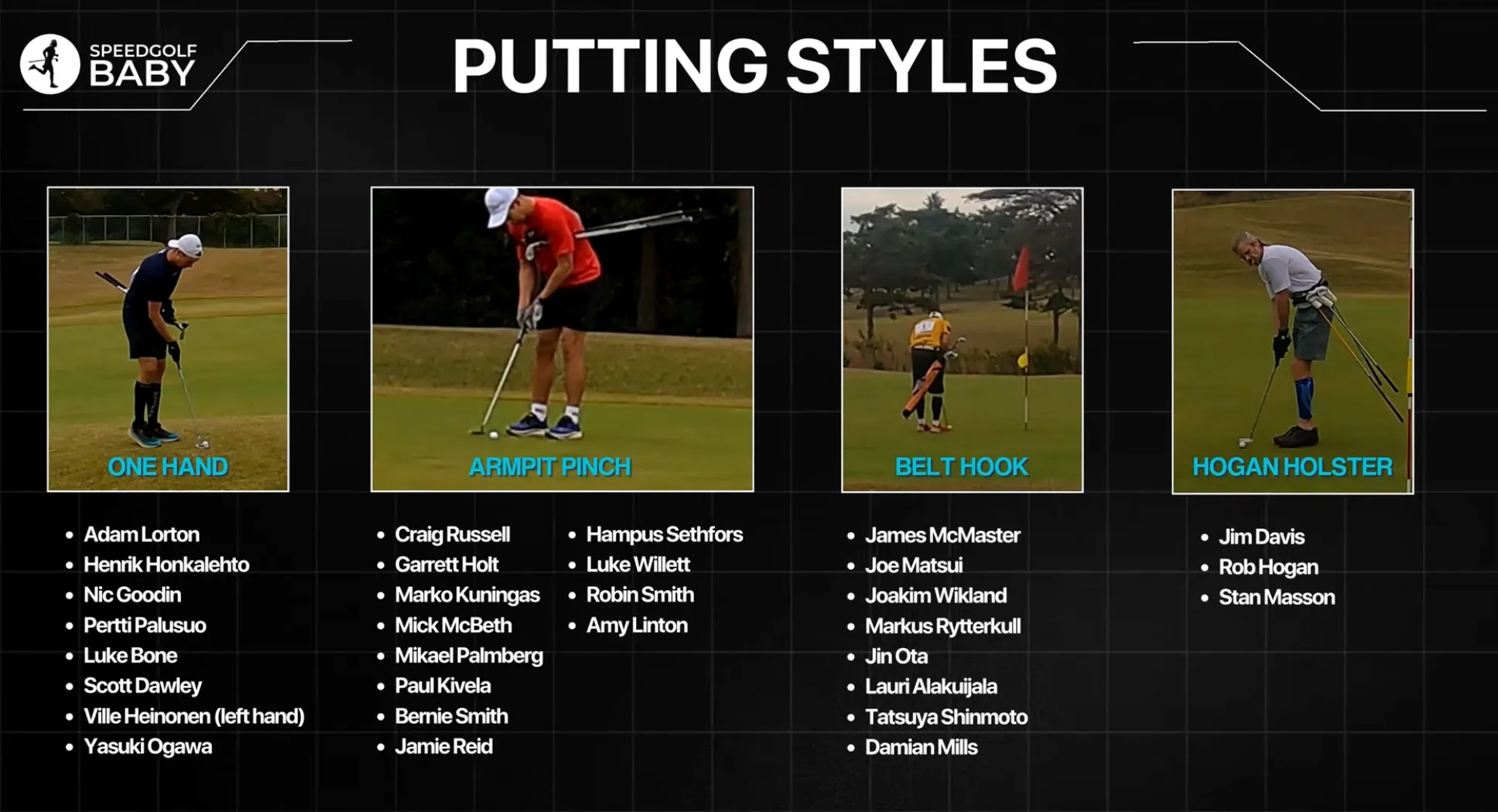
This explains why advanced players use putting styles where they keep the clubs with them: one-hand putting, armpit pinch, belt hook, or the Hogan holster. Which of those methods is best?
Student
If there were a clear winner, I think elite speedgolfers would have converged on it. My best guess is that those club carrying methods only differ by a small amount when putting. It probably depends more how a player likes to carry their clubs when they’re not on the green.
The important thing is to find a way to bring my clubs with me on the green that doesn’t interfere with my putting stroke or slow down my movement too much.
Coach
Now consider the shortest putts. Suppose a proper setup takes three to five seconds longer than a casual tap. But the casual tap is five to ten percentage points more likely to miss. How should we decide?
Student
Expected value.
Coach
Good. What is the cost of missing?
Student
3 ÷ 60 = 5%
5 ÷ 60 = about 8%
Coach
So if the casual tap is five to ten percentage points more likely to miss, what does that mean?
Student
It is right around the break-even zone. If the putt is truly automatic, casual tapping is fine. But once confidence drops, taking a real setup is worth it.
Coach
How should a player know where that line is?
Student
Test it. Hit casual taps and proper putts from one foot, one and a half feet, two feet, two and a half feet, and three feet. Find the distance where the casual tap starts losing too much make rate.
Coach
Where do you think that line is for many players?
Student
Probably around one foot. Maybe longer for elite players, shorter for nervous or developing players.
Coach
So what is the rule?
Student
Casual tap only inside my proven automatic range. Outside that, take the few seconds and make a real stroke.
Coach
Now answer the opening question again. What are you trying to accomplish around the green in speedgolf?
Student
I am trying to hole out with the lowest expected SGS, not simply play the prettiest short-game shot or move as fast as possible.
That usually means putting whenever the ball can roll safely, because the putter has low risk and often avoids a club switch.
When I cannot putt, I should choose from my practiced stock shots rather than inventing a specialty shot while tired. A bump-and-run may be best for many golfers, but the best competition shot is the one I can execute reliably under speedgolf conditions.
In bunkers and forced-carry situations, my first priority is getting the ball onto the putting surface. A longer putt is acceptable if it reduces the chance of a disaster like leaving the ball in a bunker, water, or penalty area.
On lag putts, I should read for speed and safe leave, not pretend that staring longer always improves the outcome. On short putts, I can casual tap only inside my proven automatic range.
I should also manage my effort and my clubs. Sprinting to a ball that is still rolling saves nothing, and leaving my clubs on the side of the green costs minutes over a round.
In plain English: around the green, speedgolf is about avoiding expensive little disasters. Use simple practiced shots, get the ball on the putting surface, protect against the big tail risks, and spend time only where it actually buys expected SGS.