
Coach
Today, let’s approach a question that sounds straightforward: What are you trying to accomplish when you hit an approach shot in speedgolf?
Student
Get the ball as close to the flag as possible.
Coach
That sounds reasonable. Golf is a game of proximity, isn’t it?
Student
Yes. The closer I hit it, the fewer strokes I should need.
Coach
Before we accept that answer, remind me how we evaluate any decision in speedgolf.
Student
Speedgolf score equals golf strokes plus run time plus golf time.
So:
Because one stroke is worth one minute, I can express everything in seconds:
Coach
Good. So is proximity to the flag our actual objective?
Student
Not exactly. The objective is to minimize expected SGS.
Coach
And might two balls the same distance from the hole have different expected SGS?
Student
Yes. One might be on the green and the other in rough or a bunker. They could require different expected numbers of strokes and different amounts of golf time.
Coach
Excellent. Let’s begin with targeting. Suppose you are 150 yards from the green. Where do many golfers instinctively aim?
Student
At the flag.
Coach
Why?
Student
Because the flag is the destination. A shot close to it produces a shorter putt.
Coach
Does aiming at the flag guarantee that the center of your shot pattern finishes there?
Student
No. Even if I aim there, my shots form a dispersion pattern around the target.
Coach
And is that dispersion equally harmless in every direction?
Student
No. There might be a bunker on one side, rough behind the green, or an open fairway area short.
Coach
So should you choose a target based only on the value of the perfect shot?
Student
No. I should consider the expected value of the entire shot pattern.
Coach
Express that mathematically.
Student
Something like:
I should choose the target that produces the lowest expected SGS across all likely outcomes.
Coach
Good. Suppose the flag is five yards from the right edge, with a bunker just beyond it. The center of the green is forty feet from the hole but gives your dispersion much more room. What question should you ask?
Student
Whether the expected benefit of occasionally hitting it close outweighs the increased probability of missing the green or entering the bunker.
Coach
Exactly. Now let’s examine the speedgolf belief that you should “always miss short.” Why might a speedgolfer believe that?
Student
Because a short miss does not add running distance. I run to the ball, hit the next shot, and continue toward the hole.
A long miss means I run past the hole and then come back.
Coach
Let’s quantify that directly. If a shot finishes (d) yards long, you run (d) yards past the hole and (d) yards back. At seven-minute-mile pace, what is the running penalty for each yard the ball finishes long?
Student
A seven-minute mile is 420 seconds over 1,760 yards. Because each yard long adds two yards of running:
So each yard long costs about half a second, before accounting for turning, accelerating, or decelerating.
Coach
What does that mean for misses 10 and 15 yards long?
Student
The geometric costs are:
In practice, those misses might cost about five to six seconds and eight to ten seconds, respectively.
Coach
What does a 20-yard short miss cost in additional route distance, and does that make it automatically better than a ball 10 yards long?
Student
Approximately zero. I am still progressing toward the hole. But that does not make the short miss automatically better: the 10-yard long miss costs only about five or six seconds in running, so I still need to compare the golf value of the two resulting positions.
Coach
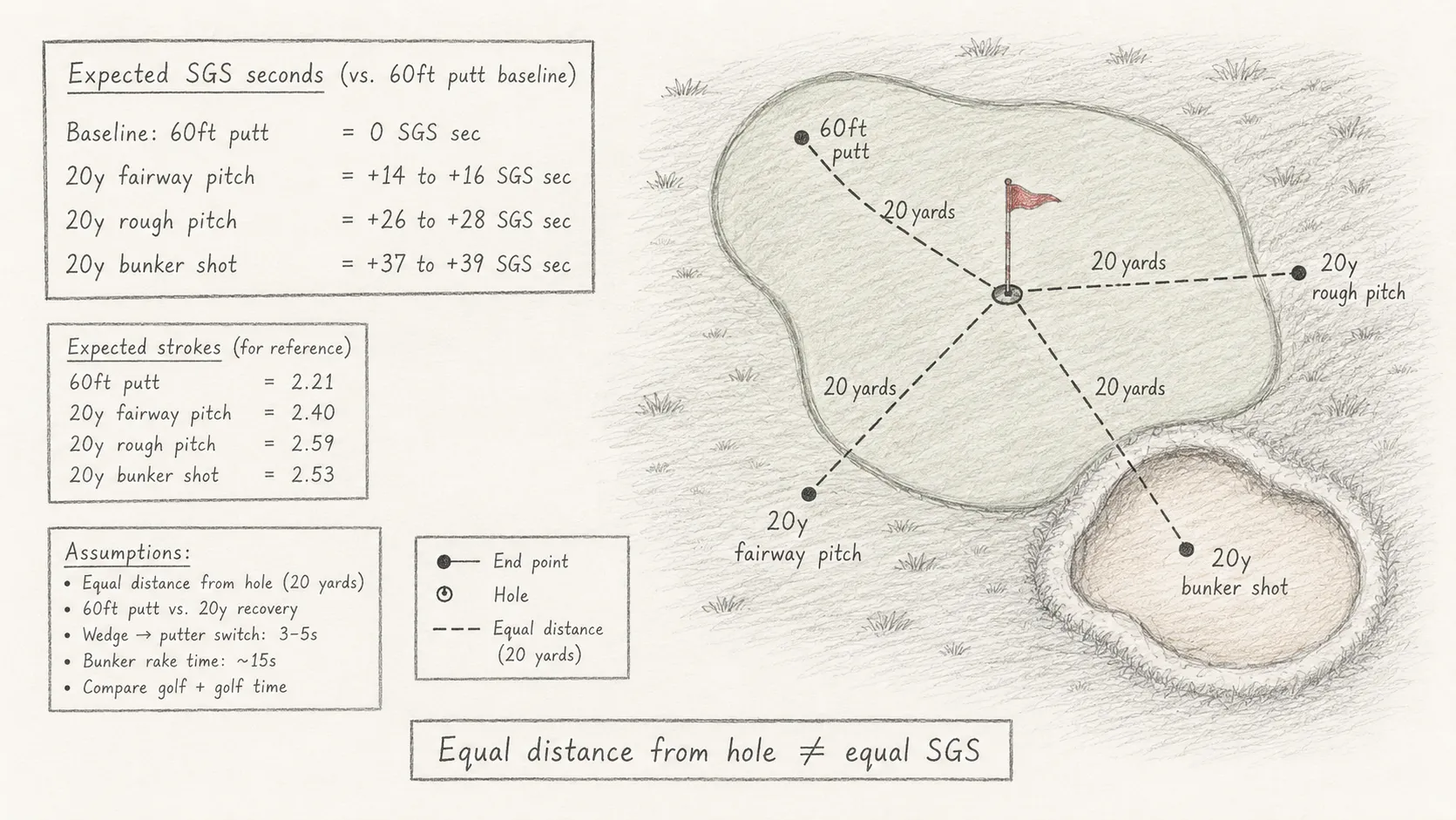
Very good. Let’s make the comparison concrete. Consider two balls both twenty yards—or sixty feet—from the hole.
One ball is on the green with a 60-foot putt. The other is short of the green with a 20-yard pitch from closely mown fairway.
For a strong benchmark, expected strokes to hole out are approximately:
- 60-foot putt: 2.21 strokes
- 20-yard fairway pitch: 2.40 strokes
How much golf value does the putt have?
Student
The difference is:
In SGS seconds:
So the putt is about eleven seconds better in expected golf score.
Coach
Does the pitch create any additional golf-time cost?
Student
Yes. I arrive near the green with my wedge in hand, hit the pitch, and then switch to the putter. That switch costs about three to five seconds.
Coach
Then what is the total SGS difference?
Student
Approximately:
So the 60-foot putt is about:
than the 20-yard fairway pitch.
Coach
Does that support the idea that leaving the ball short of the green is free?
Student
No. It may add no running distance, but it can still cost expected strokes and golf time.
Coach
Now let’s change the lie. Suppose the 20-yard pitch is from rough. Expected strokes to hole out are approximately 2.59. Compare that with the 60-foot putt.
Student
The stroke difference is:
Converted to seconds:
Then I add three to five seconds for switching from wedge to putter:
So the rough pitch costs about:
than the 60-foot putt.
Coach
And now suppose the ball finishes in a bunker, twenty yards from the hole. Expected strokes are approximately 2.53. The player also spends about five seconds placing or managing the rake and another ten seconds raking afterward.
Calculate the difference.
Student
First, the expected-stroke difference:
Then add three to five seconds to switch to the putter and fifteen seconds for the rake:
So the bunker outcome costs approximately:
than the 60-foot putt.
Coach
Rank those four outcomes, all from approximately the same distance from the hole.
Student
From best to worst:
- 60-foot putt
- 20-yard pitch from fairway or closely mown grass
- 20-yard pitch from rough
- 20-yard bunker shot
Coach
Even though the distances are equivalent?
Student
Yes. Distance from the flag is only one variable. Surface, lie, expected strokes, club switching, and maintenance time matter too.
Coach
Return now to our 10-yard long miss. You estimated that it costs about five or six seconds of running. Compare that with leaving a 20-yard fairway pitch instead of reaching the green and facing a 60-foot putt.
Student
The fairway pitch costs about fourteen to sixteen seconds relative to the putt.
So accepting a five- or six-second long-running penalty may be much better than leaving a 20-yard pitch.
Coach
What if the short miss is in rough?
Student
Then it could cost twenty-six to twenty-eight seconds relative to the long putt. That makes avoiding a small long miss even less important.
Coach
So what is wrong with “always miss short”?
Student
It ignores whether the ball finishes on the putting surface.
A short miss may save several seconds of running, but leaving the green can cost more in expected strokes and club-transition time.
Coach
Can you state a better rule?
Student
I should prefer the front portion of the green when the golf consequences are otherwise similar, because long misses create backtracking. But I should not deliberately leave the ball short of the green merely to avoid a modest chance of going long.
Coach
Good. Now suppose a golfer says, “But these are only differences of fifteen or twenty seconds. That is not very much.”
What would you ask?
Student
How often does the decision arise?
Coach
Exactly. Suppose a targeting rule creates a quarter-stroke disadvantage each time it matters. How much is that in SGS?
Student
A quarter stroke is:
Coach
And if the rule affects eight approach shots in a round?
Student
Then:
That is two full minutes, or two SGS strokes.
Coach
So can a small repeated error become strategically important?
Student
Yes. Rules of thumb matter precisely because they are repeated. A fifteen-second mistake made once is modest. The same mistake made eight times costs two minutes.
Coach
Let’s turn to club selection. Why might a new speedgolfer think more clubs automatically improve approach play?
Student
More clubs create smaller yardage gaps. That should make it easier to hit the ball close to the desired distance.
Coach
Does an extra club have any cost?
Student
Yes. It adds weight and can slow the running pace. It also crowds the carrying device and can add handling time when selecting, replacing, or organizing clubs.
Coach
Suppose adding a fifth club costs somewhere around forty-five to ninety seconds over a round. How much approach improvement must it create simply to break even?
Student
It must save:
That is equivalent to:
to:
So the extra club must improve expected golf performance by roughly three-quarters of a stroke to one and a half strokes per round.
Coach
Does merely creating prettier yardage gaps prove that it does?
Student
No. I would need to estimate how often the additional club actually changes the outcome.
Coach
Suppose I replace one 7-iron with both a 6-iron and a 9-iron. What should I examine?
Student
I should map the course’s likely approach distances and ask:
- How many shots are meaningfully improved by the 6-iron or 9-iron?
- Would the 7-iron have produced an acceptable shot anyway?
- Does the extra club reduce misses off the green, especially into rough or bunkers?
- How often does it turn a pitch into a putt?
- Does it reduce expected strokes enough to offset its running and handling penalty?
Coach
And should you compare only full-swing yardages?
Student
No. Speedgolfers often have only one or two realistic approach clubs. I should consider the useful distance range of each club, including choked-down swings, partial swings, trajectory control, and performance under fatigue.
Coach
You mentioned fatigue. Why is that important?
Student
A shot that is technically possible on the range may not be reliable at a high heart rate. A perfectly calibrated partial shot is less valuable if it becomes unpredictable during a round.
Coach
Suppose a player has excellent control with a full wedge but poor control with an extremely choked-down 7-iron. Does that justify favoring the wedge?
Student
It might. But I should compare the entire outcome distributions.
The full wedge may produce tighter dispersion and fewer catastrophic misses. The choked-down 7-iron might have a wider distance pattern or be more likely to go long.
Coach
Does that prove that every short wedge result is better than every long 7-iron result?
Student
No. It only means the wedge may produce the lower expected SGS distribution.
Club choice and outcome value are related, but they are not the same question.
Coach
Well put. Now consider two targets.
Target A is directly at the flag. It creates:
- A 20% chance of a putt inside 20 feet
- A 45% chance of a putt between 20 and 60 feet
- A 20% chance of a pitch from rough
- A 15% chance of a bunker shot
Target B is toward the broad front-middle of the green. It creates:
- A 10% chance of a putt inside 20 feet
- A 70% chance of a putt between 20 and 60 feet
- A 15% chance of a fairway pitch
- A 5% chance of a bunker shot
Which target looks more attractive?
Student
Target A creates more close putts, but it also creates more rough and bunker outcomes.
Target B produces fewer very close shots but far more putts and fewer expensive misses.
I would need exact expected-stroke values to calculate it precisely, but Target B may have lower expected SGS because it keeps more of the shot pattern on the green and reduces the expensive tail.
Coach
What is the “expensive tail”?
Student
The small number of outcomes that cost far more than an ordinary miss—bunkers, thick rough, penalty areas, short-sided pitches, or shots requiring unusual recovery time.
Coach
And is the ideal target necessarily the center of the green?
Student
No. It depends on the shape of the green, flag location, hazards, my shot dispersion, and my available club.
But the correct target is often farther from the flag than instinct suggests.
Coach
Let’s revisit the front-versus-back question. Suppose the green is open in front, rough behind, and slopes from back to front. How does that affect strategy?
Student
It strengthens the case for a short-biased target.
A front-green result leaves an uphill putt. A slight short miss may leave an uphill pitch from fairway. A long miss may require backtracking and leave a downhill shot from rough.
Coach
Does that mean the player should choose a club whose normal shot finishes twenty yards short?
Student
No. The primary goal should still be to get the ordinary dispersion onto the green.
The target and club can bias the pattern toward the front portion of the green without centering the pattern short of the green.
Coach
Suppose the front is guarded by a bunker and the back is open fairway. What happens to the rule?
Student
It may reverse. Missing long could be better than missing short because the golf and maintenance cost of the bunker could easily outweigh a few seconds of backtracking.
Coach
So is “short” intrinsically good?
Student
No. “Short” is only good when the resulting state has lower expected SGS.
Coach
Very good. Now let’s consider par-3 tee shots. Is the analysis fundamentally different?
Student
No. It is still an approach shot. I should evaluate the entire shot distribution, the likelihood of hitting the green, the likely misses, and the expected SGS from each outcome.
Coach
But is there one important speedgolf difference on a par 3?
Student
Because I begin from rest at the tee, the club choice can determine whether I reach the green at all. If I choose a club that frequently finishes well short, I may create a pitch and a later club switch on a large percentage of the holes.
Coach
And if a slightly longer club sometimes finishes ten yards beyond the green?
Student
That creates perhaps five or six seconds of running penalty, but it may still be better if it turns many 20-yard pitches into long putts.
Coach
Now let’s assemble a ranking. Imagine the following approach outcomes, with no penalty area involved:
- Ball on the green, 15-foot putt
- Ball on the green, 40-foot putt
- Ball on the green, 60-foot putt
- Ball 5 yards long in open fairway
- Ball 20 yards short in closely mown fairway
- Ball 20 yards short in rough
- Ball 20 yards short in a bunker
- Ball 10 yards long in thick rough
- Ball short-sided in a bunker
How would you rank them from most desirable to least?
Student
Subject to the exact slope and lie, I would rank them approximately:
- Ball on the green, 15-foot putt
- Ball on the green, 40-foot putt
- Ball on the green, 60-foot putt
- Ball 5 yards long in open fairway
- Ball 20 yards short in closely mown fairway
- Ball 20 yards short in rough
- Ball 10 yards long in thick rough
- Ball 20 yards short in a bunker
- Ball short-sided in a bunker
The exact order of the middle outcomes could change. For example, a simple 5-yard fairway chip might be better than a 60-foot putt, and a difficult green could change the putting values.
But the main lesson is that a small long miss in a good lie can easily be preferable to a much farther short miss, and any on-green result is often better than an equal-distance off-green result.
Coach
Why did you not rank every short outcome ahead of every long outcome?
Student
Because direction alone does not determine value.
I must account for:
- Expected strokes to hole out
- Whether the ball is on the green
- Lie and slope
- Hazards
- Club-switching time
- Bunker-maintenance time
- Extra running from backtracking
Coach
And how would you now answer our opening question? What are you trying to accomplish with an approach shot in speedgolf?
Student
I am not merely trying to hit the ball as close to the flag as possible.
I am trying to choose a club and target that minimize expected SGS across my whole shot pattern.
That usually means giving substantial value to hitting the green, even if the resulting putt is long. A 60-foot putt can be around fifteen seconds better than an equal-distance fairway pitch, nearly thirty seconds better than a rough pitch, and close to forty seconds better than a bunker shot once the rake and club switch are included.
I should allow the architecture of the hole to shape my target. When the front and back are otherwise similar, I should favor the front portion of the green because long misses create backtracking. But I should not deliberately leave the ball short of the green merely to avoid a small chance of going long.
I also should not assume that more clubs automatically improve my score. An extra club must save enough expected golf strokes, repeatedly across the round, to offset its running and handling cost.
In plain English: get the ordinary shot pattern onto the safest useful part of the green, avoid the expensive misses, and judge small advantages by how often they repeat over the round.